
Why Is My AC Running but Not Cooling My Surrey Home?
An air conditioner can continue running even when it is not properly removing heat from your home. Common causes include an incorrect thermostat setting, a clogged filter, restricted airflow, a dirty outdoor coil, frozen equipment, a refrigerant leak, or a failing electrical component.
Start with the safe checks in this guide. If the system is frozen, making unusual noises, repeatedly tripping a breaker, or blowing warm air after the basic checks, switch it off and arrange professional service.
Looking for AC Repair?
Accolade Heating services permanently installed residential cooling systems, including central air conditioners, ductless mini-splits and heat pumps.
We do not repair portable, freestanding or window air-conditioning units.
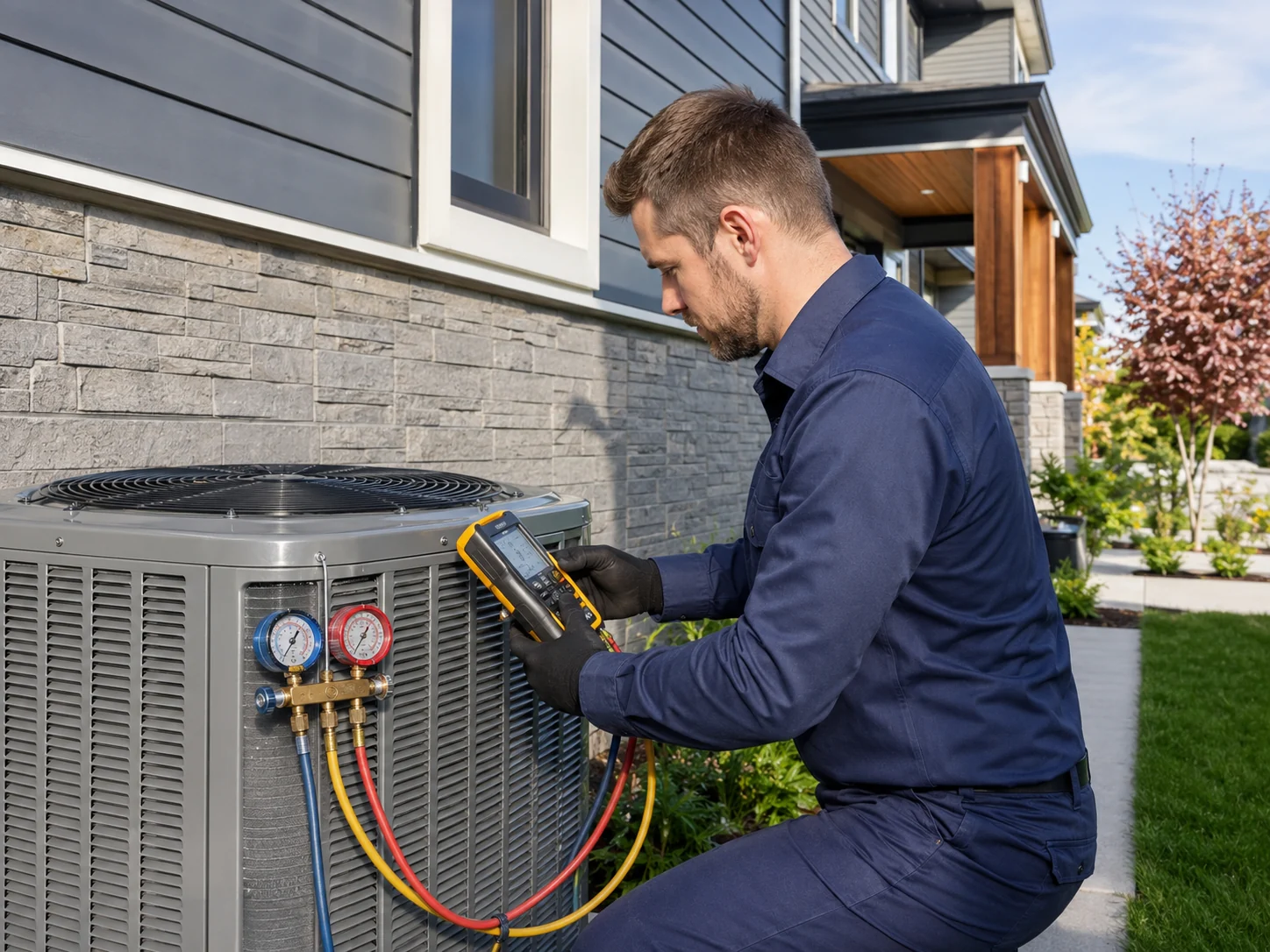
Quick answer: Why is my AC running but not cooling?
Your AC may be running without cooling because air is not moving properly through the system or because the refrigeration cycle is not working.
The most common possibilities are:
- The thermostat is set incorrectly
- The air filter is clogged
- Supply or return vents are blocked
- The outdoor condenser is dirty or obstructed
- The indoor evaporator coil is frozen
- Refrigerant is leaking
- A capacitor, fan motor, contactor, or compressor is failing
- The ductwork is leaking, or the system is improperly sized
Some of these problems can be checked safely by a homeowner. Refrigerant, electrical, compressor, and internal equipment problems require a trained HVAC technician.
How does an AC run without producing cold air?
A central air conditioner has two main jobs. It absorbs heat through the indoor evaporator coil and releases that heat through the outdoor condenser.
The blower can continue moving air through your vents even when the cooling part of this process has stopped. That is why you may hear the system operating but feel room-temperature or warm air coming from the registers.
The location of the problem can often be narrowed down by checking:
- Whether airflow is strong or weak
- Whether the outdoor unit is operating
- Whether ice is visible on the refrigerant line
- Whether every room is warm or only certain rooms
- Whether the system runs continuously
- Whether there are unusual sounds, smells, or leaks
1. The thermostat is set incorrectly

Check the thermostat before assuming that the AC has suffered a major failure.
Make sure:
- The operating mode is set to COOL
- The selected temperature is below the current room temperature
- The fan setting is on AUTO, not ON
- The thermostat display is active
- The schedule has not automatically changed the temperature
- The thermostat is not receiving direct sunlight
When the fan is set to ON, the blower may circulate air even when the outdoor cooling system is not operating. This can make it feel as though the AC is running but producing warm air.
Change the fan setting to AUTO, lower the temperature slightly, and allow the system several minutes to respond.
2. A dirty filter is restricting airflow
A clogged filter limits the amount of warm household air that can pass over the indoor evaporator coil. Cooling performance drops, airflow at the vents becomes weaker, and the system may run much longer than normal.
Severely restricted airflow can also contribute to the evaporator coil freezing.
Switch the system off and inspect the filter. Replace it when it is visibly dirty or when it has reached the replacement interval recommended for the filter and equipment.
Do not operate the system without the correct filter. The filter helps protect the blower, coil, and other internal components from dust and debris.
If replacing the filter restores airflow but not cooling, another issue may be present.
3. Vents or return-air openings are blocked
Closed supply vents, covered return grilles, and obstructed registers can interfere with airflow.
Check whether:
- Furniture is covering a return-air grille
- Rugs or curtains are blocking floor registers
- Supply vents have been closed in unused rooms
- Several rooms receive much less airflow than others
- A basement suite or renovation has changed the original airflow pattern
Opening all normal supply registers is generally better than closing several vents to redirect air. Closing too many can increase pressure in the duct system and may reduce overall performance.
If only one area of the home remains warm, the problem may involve duct leakage, poor balancing, insulation, or the layout of the home rather than the outdoor AC unit itself.
4. The outdoor condenser cannot release heat

The outdoor unit must move air through its coil to release the heat removed from your home. Leaves, grass clippings, dirt, plants, storage items, and other debris can restrict this airflow.
With the system switched off, look around the outdoor unit and remove loose debris from the surrounding area. Do not bend the coil fins, remove panels, or use a high-pressure washer.
Professional cleaning may be needed when dirt is embedded in the coil or the equipment has not been maintained recently.
A dirty or obstructed condenser may cause:
- Long cooling cycles
- Warm indoor air
- Higher electricity use
- Overheating
- Compressor stress
- Reduced cooling on hotter afternoons
Regular air-conditioning maintenance can identify coil contamination, airflow restrictions, electrical wear, and other developing problems before peak summer demand.
5. The evaporator coil is frozen

Ice on the indoor coil or refrigerant line is not a sign that the AC is producing extra cooling. It means the system is not transferring heat correctly.
Possible causes include:
- A clogged air filter
- Restricted return airflow
- A dirty evaporator coil
- A blower problem
- Low refrigerant caused by a leak
- Operating or control problems
Signs of a frozen AC system include weak airflow, reduced cooling, visible frost, water near the indoor equipment after the ice melts, or cooling that gradually becomes worse.
Turn cooling off if you see ice. Continuing to operate a frozen system can place additional strain on the compressor.
Do not scrape the ice or apply direct heat. Allow the equipment to thaw naturally and arrange an inspection if it freezes again.
6. The system may have a refrigerant leak
An air conditioner does not normally consume refrigerant during regular operation. If the refrigerant charge is low, there may be a leak or a problem with the original installation or service.
Possible warning signs include:
- The AC runs for long periods without reaching the set temperature
- The air from the vents is not sufficiently cool
- Ice forms on the refrigerant line or indoor coil
- A hissing or bubbling sound is present
- Cooling performance has gradually declined
- Electricity use increases without an obvious explanation
Adding refrigerant without finding the cause is not a complete repair. A technician must inspect the system, identify the leak or fault, complete the necessary repair, and confirm that the equipment has the correct refrigerant charge.
Refrigerant work should not be treated as a homeowner repair.
7. An electrical or mechanical component is failing
The indoor blower may run even when an outdoor component has failed.
Potential faults include:
- A weakened or failed capacitor
- A damaged contactor
- An outdoor fan motor problem
- A thermostat or control-board fault
- Loose or damaged wiring
- A compressor problem
- A tripped safety control
Call for service when the outdoor unit hums without starting, the fan is not turning, the system repeatedly starts and stops, or a breaker continues to trip.
Do not repeatedly reset a breaker. A breaker that trips again may be responding to an electrical or equipment fault that requires diagnosis.
Accolade provides professional AC repair in Surrey for central air conditioners, ductless systems, and heat pumps that are not cooling correctly.
AC symptom and possible cause guide
| What you notice | Possible causes |
|---|---|
| Strong airflow but warm air | Thermostat setting, outdoor-unit fault, refrigerant problem or compressor issue |
| Weak airflow from most vents | Dirty filter, blower problem, frozen coil or duct restriction |
| Some rooms cool and others stay warm | Duct leakage, airflow imbalance, insulation or layout issue |
| Ice on the refrigerant line | Airflow restriction, dirty coil or low refrigerant |
| Outdoor unit is silent | Power, control, contactor, capacitor or compressor fault |
| Outdoor unit hums but the fan does not move | Capacitor or fan-motor problem |
| AC runs constantly | Dirty coils, low refrigerant, undersized equipment, duct leakage or high heat gain |
| Breaker repeatedly trips | Electrical fault, motor problem or compressor issue |
This table can help describe the problem when booking service, but it does not replace equipment testing.
What can I safely check before calling a technician?
Homeowners can usually complete these basic checks:
- Confirm that the thermostat is set to COOL.
- Change the fan setting from ON to AUTO.
- Set the temperature below the current indoor temperature.
- Inspect and replace a dirty air filter.
- Confirm that normal supply and return vents are open.
- Remove loose debris from around the outdoor equipment.
- Look for visible ice, water, unusual sounds, or unusual smells.
- Check whether the outdoor fan is operating without touching the unit.
After correcting a thermostat or filter issue, allow the system time to begin a normal cooling cycle.
Do not open equipment panels, touch electrical components, handle refrigerant lines, bypass safety devices, or repeatedly reset a breaker.
When should I switch the AC off?
Switch the system off and request professional help when:
- Ice is forming on the coil or refrigerant line
- The outdoor fan is not operating
- The breaker trips more than once
- You notice a burning or electrical smell
- The unit makes grinding, buzzing, or loud mechanical noises
- Water is spreading around the indoor equipment
- The system runs continuously without lowering the temperature
- Warm air continues after the thermostat, filter, and vents have been checked
Prompt diagnosis may help prevent a smaller airflow or electrical problem from causing additional equipment damage.
Does a heat pump have the same cooling problems?
During summer, an air-source heat pump cools a home using a process similar to a central air conditioner. It can therefore experience many of the same problems, including:
- Dirty filters or coils
- Restricted airflow
- Refrigerant leaks
- Frozen indoor coils
- Fan or capacitor failures
- Thermostat and control problems
A heat pump can also have a reversing-valve or mode-control problem that prevents it from switching correctly into cooling mode.
Tell the technician whether your home uses a conventional central AC or a heat pump. That information helps direct the diagnostic process.
Should I repair or replace an AC that is not cooling?
An AC that is not cooling does not automatically need to be replaced. A filter, thermostat, capacitor, dirty coil, or minor electrical problem may be repairable.
Replacement becomes more reasonable when:
- The system is approaching the end of its practical service life
- It requires repeated repairs
- A major component has failed
- The equipment is improperly sized
- Cooling performance has remained poor despite repairs
- Replacement would significantly improve comfort or efficiency
- The current system no longer suits renovations or changes to the home
Use the complete AC repair versus replacement guide to compare the two options without turning a troubleshooting decision into a guess.
For budgeting information, review the factors that affect AC repair costs in Surrey. The final cost depends on the diagnosed fault, required parts, equipment accessibility, and system condition.
How can I prevent this problem?
Preventive steps include:
- Replacing filters when required
- Keeping indoor and outdoor airflow unobstructed
- Keeping vegetation and debris away from the outdoor unit
- Scheduling maintenance before the hottest part of summer
- Paying attention to weaker airflow and longer cooling cycles
- Addressing unusual sounds before the system stops cooling
- Having ductwork evaluated when rooms remain uneven
- Avoiding repeated thermostat adjustments that do not address the fault
Maintenance cannot prevent every component failure, but it can identify dirty coils, weak electrical components, airflow problems, and other developing concerns.
Frequently asked questions
Why is my AC blowing air but the air is not cold?
The blower may be operating while the outdoor cooling system is not. Check the thermostat, filter, vents, and outdoor equipment. Refrigerant, electrical, frozen-coil, or compressor problems require professional diagnosis.
Can a dirty air filter make an AC stop cooling?
Yes. A heavily clogged filter can reduce airflow, weaken cooling, lengthen operating cycles, and contribute to a frozen evaporator coil.
Should I turn off my AC if it is running but not cooling?
Turn it off if you see ice, smell burning, hear serious mechanical noises, experience repeated breaker trips, or receive no cooling after basic thermostat and filter checks.
Why is my AC colder at night but not during the day?
The system may be struggling when the cooling demand is highest. Possible causes include dirty coils, low refrigerant, duct leakage, an undersized system, excessive heat entering the home, or declining equipment performance.
Will lowering the thermostat make the house cool faster?
No. Selecting a much lower temperature does not correct an airflow, refrigerant, electrical, or equipment fault. It may simply cause the system to run longer.
Get an AC that runs and cools properly
If your AC continues running without lowering the temperature, the next step is to identify whether the problem involves airflow, refrigerant, electrical controls, ductwork, or the equipment itself.
Accolade Heating & Air Conditioning serves Surrey and nearby communities with AC troubleshooting, maintenance, and repair. Request an HVAC assessment to have the system properly tested before a minor problem develops into a larger failure.