
Why Is My Furnace Blowing Cold Air in Surrey?
A furnace may blow cold air because its fan is set to run continuously, the filter is restricting airflow, the burners have failed to ignite, or a safety control has shut the heat off. A brief burst of cool air at the beginning or end of a heating cycle can be normal. Cold air that continues while the thermostat is calling for heat usually requires troubleshooting.
Start by checking the thermostat, filter, vents, and whether the furnace begins a normal heating cycle. Do not open the combustion compartment, handle gas components, bypass a safety control, or repeatedly restart a furnace that keeps shutting down.
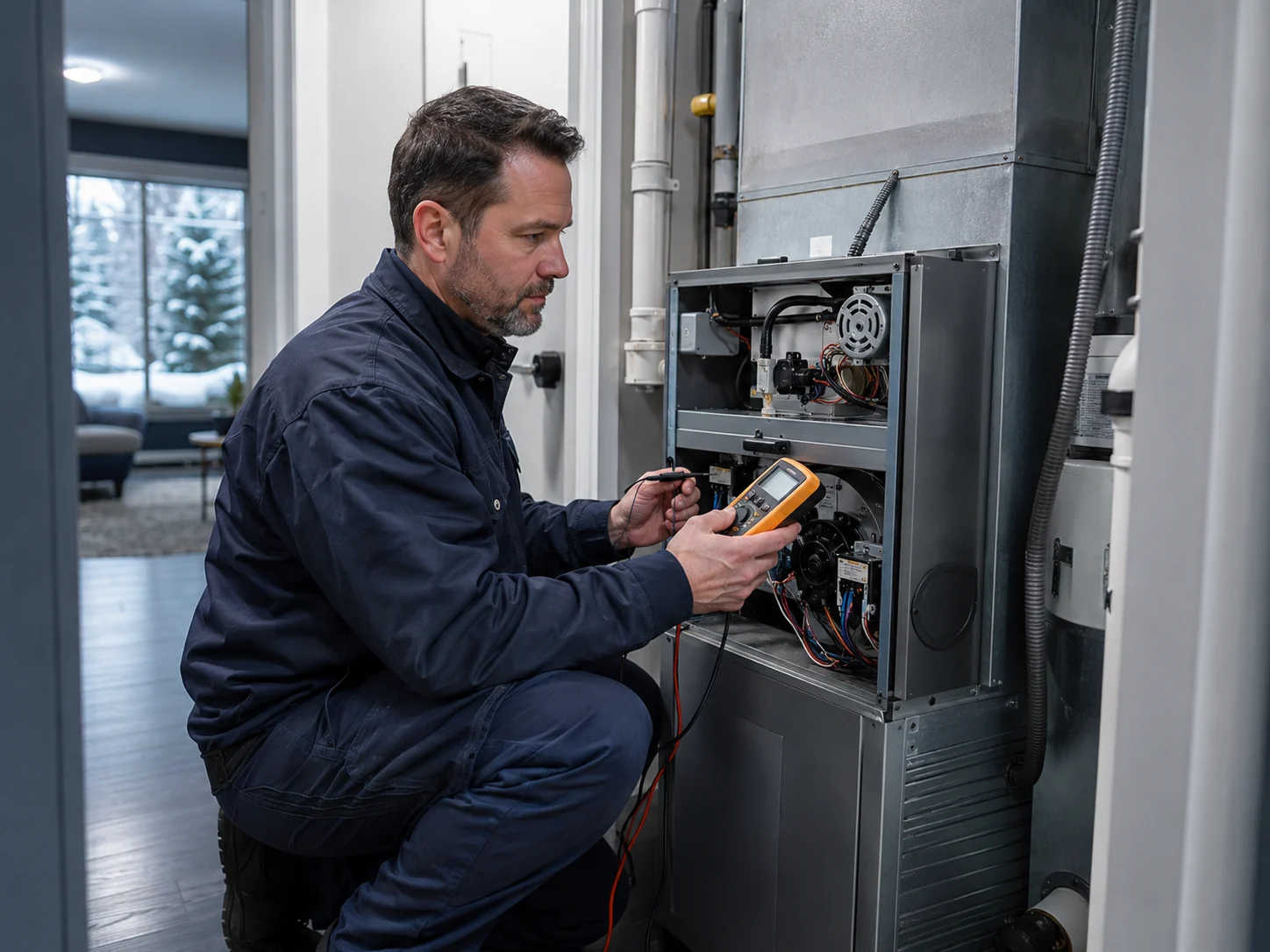
Quick answer: Why is my furnace blowing cold air?
The most common causes are:
- The thermostat fan is set to ON instead of AUTO
- The furnace has not finished warming up
- The air filter is clogged
- Too many vents or return grilles are blocked
- The furnace is overheating and shutting the burners off
- The ignition system or flame sensor is failing
- A high-efficiency furnace has a condensate drainage problem
- The gas supply, control board, blower, or another component has failed
- Heat is being lost through damaged or disconnected ductwork
Homeowners can safely check the thermostat, filter, and accessible vents. Problems involving gas, combustion, wiring, burners, flame sensors, safety switches, or internal furnace parts should be diagnosed by a qualified technician.
Is a brief period of cold air normal?
A short burst of cool or room-temperature air can be normal when the furnace first starts. The air sitting inside the ductwork may feel cool until the heat exchanger warms and heated air reaches the registers.
You may also feel a small amount of cooler air at the end of a cycle while the blower removes remaining heat from the furnace.
It is more likely to indicate a problem when:
- The air never becomes warm
- The furnace repeatedly starts and stops
- Warm air changes to cold air during the cycle
- The blower runs continuously
- The thermostat temperature keeps falling
- The burners ignite briefly and shut down
- The furnace displays or flashes a fault code
- The home cannot reach the selected temperature
The duration and pattern of the cold airflow are often more useful than the air temperature alone.
1. The thermostat fan is set to ON

Check the thermostat before assuming that the furnace has failed.
The thermostat should generally be set to:
- Mode: HEAT
- Fan: AUTO
- Temperature: Above the current room temperature
When the fan is set to ON, the blower operates continuously, including between heating cycles. During those periods, it circulates unheated household air through the vents.
Changing the fan setting to AUTO allows it to operate mainly when the furnace is actively heating.
Also check whether:
- The thermostat schedule recently changed
- The batteries need replacement
- The thermostat was accidentally switched to cooling
- A smart thermostat has lost its connection or configuration
- The displayed room temperature appears inaccurate
If the thermostat is correctly configured but the furnace still cannot complete a heating cycle, continue with the other checks.
2. The furnace filter is clogged

A furnace needs adequate airflow to move heat safely through the system. A clogged filter can reduce airflow, weaken heating performance, and cause the furnace to overheat.
When overheating occurs, a safety control may shut the burners off while allowing the blower to continue running. The air from the vents can then become cool even though the furnace fan remains active.
Signs of restricted airflow include:
- Weak airflow from several vents
- A filter covered with visible dust
- A furnace that starts and stops frequently
- A blower that runs longer than expected
- Rooms that heat unevenly
- Unusual furnace noise
- A furnace cabinet that appears unusually hot
Turn the furnace off using the normal control, inspect the accessible filter, and replace it with the correct type and size when it is dirty.
Do not install a filter with a different resistance rating unless it is suitable for the system. An overly restrictive filter can also affect airflow.
For preventive guidance, review how often a furnace should be serviced in BC.
3. Supply vents or return grilles are obstructed
The furnace must pull air through return grilles and send heated air back through supply registers.
Check for:
- Furniture covering return grilles
- Rugs blocking floor registers
- Closed vents in unused rooms
- Stored items placed against furnace-room airflow openings
- Dust buildup on accessible grilles
- Renovations that changed the original duct layout
Closing several supply vents does not necessarily reduce heating costs. It can increase pressure inside the duct system and contribute to poor airflow.
Keep normal supply and return openings accessible. If only certain rooms receive cold or weak air, the issue may involve duct balancing, leakage, insulation, or disconnected ductwork rather than the furnace itself.
4. The furnace is overheating
A furnace can overheat when it cannot move enough air across the heat exchanger.
Possible causes include:
- A dirty filter
- Blocked vents
- A dirty blower assembly
- A failing blower motor
- An incorrectly sized filter
- Duct restrictions
- Internal buildup or mechanical problems
The furnace’s limit control is designed to stop burner operation when temperatures become unsafe. The blower may continue running to cool the equipment, producing cold air from the vents.
Repeated overheating should not be treated as a normal inconvenience. It can stress furnace components and may cause the heating system to lock out.
If a clean filter and open vents do not resolve repeated shutdowns, arrange professional furnace repair in Surrey.
5. The ignition system or flame sensor is failing

Modern furnaces commonly use an electronic ignition system rather than a continuously burning pilot light.
A normal sequence usually includes:
- The thermostat requests heat.
- The furnace begins its safety checks.
- The ignition system starts.
- The burners ignite.
- The flame is verified.
- The blower begins distributing warm air.
If the ignition system cannot light the burners, or the furnace cannot confirm a stable flame, it may shut the gas valve as a safety measure. The blower may still operate, resulting in cold air.
Possible symptoms include:
- Clicking without burner ignition
- Burners that light and shut off after a few seconds
- Repeated attempts to start
- A flashing furnace fault code
- A blower running without visible or audible burner operation
- Heat that works intermittently
A contaminated flame sensor, failed igniter, gas-valve problem, wiring fault, or control issue may be responsible.
These are not homeowner repair items. Do not open the burner compartment or attempt to bypass the furnace’s ignition or flame-safety controls.
6. A high-efficiency furnace has a condensate problem
High-efficiency furnaces produce water during normal operation. That moisture must drain properly through the condensate system.
A blocked drain, failed condensate pump, frozen line, or triggered safety switch can prevent the furnace from heating correctly. The burners may remain off while the blower continues to circulate unheated air.
Possible signs include:
- Water near the furnace
- Gurgling or unusual drainage sounds
- Heating that stops unexpectedly
- A condensate pump that runs continuously
- A visible furnace fault code
- Cold air following an attempted heating cycle
Do not ignore water around furnace equipment. It can indicate a drainage fault, damaged component, or another condition requiring inspection.
7. The furnace is not receiving the correct fuel or control signal
A gas furnace can fail to heat when it is not receiving gas correctly or when a control prevents the gas valve from opening.
Potential causes include:
- An interrupted gas supply
- A faulty gas valve
- A pressure-switch problem
- A venting or combustion-air problem
- An ignition-control fault
- A control-board problem
- A tripped safety device
Do not attempt to repair, adjust, or test a gas valve or combustion component.
If you smell rotten eggs or suspect a gas leak, stop what you are doing, get everyone outside, and call the FortisBC emergency line at 1-800-663-9911 or 911 from outside. Do not operate electrical switches or use a phone inside the building.
8. Ductwork is leaking or disconnected
The furnace may be producing heat correctly, but damaged ductwork can prevent that heat from reaching the rooms.
Possible clues include:
- One section of the home stays colder than the rest
- Airflow suddenly becomes weaker in one room
- Utility spaces feel unusually warm
- You hear air escaping near accessible ductwork
- Heating performance changed after a renovation
- The furnace runs normally but the house remains uncomfortable
Leaking ducts can lose heated air into a crawlspace, attic, garage, wall cavity, or utility area. Unconditioned air may also enter the duct system and make supply air feel cooler.
A technician can evaluate static pressure, temperature rise, airflow, and visible duct conditions to determine whether the complaint originates in the furnace or the distribution system.
Furnace symptom and possible cause guide
| What you notice | Possible explanation |
|---|---|
| Cool air only at startup | Cold air was sitting in the ductwork |
| Blower runs constantly | Thermostat fan set to ON, control issue, or safety shutdown |
| Burners start and stop quickly | Flame-sensor, ignition, overheating, venting, or control problem |
| Weak air from most vents | Clogged filter, blower issue, or duct restriction |
| Warm air changes to cold air | Burner shutdown, overheating, or interrupted ignition cycle |
| Water around the furnace | Condensate drain, pump, or high-efficiency furnace issue |
| Only one room receives cold air | Duct leakage, disconnected duct, or airflow imbalance |
| Furnace repeatedly attempts to start | Ignition, gas, pressure-switch, flame-sensing, or control fault |
| Rotten-egg smell | Possible natural-gas leak; leave immediately and call from outside |
| Carbon-monoxide alarm activates | Leave the building and call emergency services |
What can I safely check myself?
Homeowners can generally perform these limited checks:
- Confirm the thermostat is set to HEAT.
- Set the fan to AUTO.
- Raise the selected temperature slightly above room temperature.
- Replace weak thermostat batteries.
- Inspect and replace a dirty furnace filter.
- Confirm accessible supply and return vents are open.
- Check whether the furnace switch was accidentally turned off.
- Note any displayed or flashing fault code without removing panels.
- Record whether the burners start, stop, or never ignite.
- Listen for unusual clicking, buzzing, grinding, or repeated startup attempts.
These observations can help a technician diagnose the problem more efficiently.
Do not:
- Remove the combustion compartment
- Adjust the gas valve
- Handle burners or ignition components
- Clean or bypass a flame sensor without proper training
- Bypass a pressure, limit, or condensate switch
- Repeatedly restart a furnace that locks out
- Continue operating equipment when a gas or CO warning is present
When should I turn off the furnace?
Turn the furnace off using its normal control and request service when:
- It repeatedly overheats or shuts down
- The burners ignite and immediately go out
- Cold air continues after the thermostat and filter checks
- Water is present around the equipment
- You hear grinding, banging, or loud electrical buzzing
- A breaker repeatedly trips
- The furnace repeatedly displays a fault code
- The home temperature is falling during cold weather
- You see soot or unusual discolouration
- You suspect an ignition, venting, or combustion problem
A gas smell or carbon-monoxide alarm requires a different response: leave the building immediately and contact emergency services or FortisBC from outside.
Is it actually a furnace or a heat pump?
A heat pump can produce supply air that feels less hot than air from a gas furnace while still heating the home normally. It may also deliver temporarily cooler air during a defrost cycle.
A gas furnace blowing continuously cold air is different. It often indicates that the burners are not operating, the furnace has shut the burners down for safety, or the blower is running outside an active heating cycle.
Before troubleshooting, confirm which heating system the home uses. Some properties have a heat pump with a furnace providing backup heat.
Does a furnace blowing cold air need repair or replacement?
Cold air alone does not prove that the entire furnace needs replacement. A thermostat problem, clogged filter, igniter, flame sensor, condensate blockage, or minor electrical component may be repairable.
Replacement deserves consideration when:
- The furnace has become unreliable
- Major components have failed
- The heat exchanger is unsafe
- Repairs are becoming frequent
- The furnace cannot maintain comfortable temperatures
- The equipment is approaching the end of its service life
- The system is poorly sized for the home
- A planned upgrade would better suit the property
Read how long furnaces typically last in BC before treating age alone as the deciding factor.
The furnace repair versus replacement guide can help separate a repairable fault from a broader replacement decision.
How much can furnace repair cost?
The final price depends on the diagnosed cause, required part, equipment model, accessibility, service timing, and whether more than one fault is present.
A thermostat or filter problem is different from an igniter, blower motor, control board, gas valve, venting fault, or major furnace failure.
Review the factors that influence furnace repair costs in Surrey rather than estimating the repair from the symptom alone.
How can I prevent another cold-air problem?
Preventive steps include:
- Checking filters regularly
- Keeping supply and return openings clear
- Avoiding storage around furnace equipment
- Paying attention to longer or shorter heating cycles
- Scheduling maintenance before heating season
- Addressing fault codes and unusual sounds promptly
- Testing carbon-monoxide alarms
- Having gas appliances serviced by qualified professionals
- Correcting duct leakage and airflow problems
Regular furnace maintenance can identify restricted airflow, ignition wear, combustion concerns, drainage problems, weak components, and developing safety faults before they result in a loss of heat.
Frequently asked questions
Why does my furnace blow cold air before warm air?
A brief period of cool air can occur while the furnace warms and pushes unheated air out of the ductwork. It becomes a concern when the air stays cold or the burners do not complete a normal cycle.
Can a dirty furnace filter cause cold air?
Yes. A clogged filter can restrict airflow and make the furnace overheat. A safety control may shut the burners off while the blower continues running.
Why does the furnace ignite and then shut off?
The furnace may be unable to verify a stable flame, or another safety control may be interrupting operation. Flame-sensor, ignition, airflow, venting, gas, condensate, and control faults are possible.
Should I reset a furnace that is blowing cold air?
Do not repeatedly reset a furnace. A single interruption may clear a minor control issue, but recurring shutdowns or lockouts require diagnosis. Repeated resets can hide the pattern a technician needs to identify.
Is a furnace blowing cold air an emergency?
It is urgent when the home is losing heat in cold weather. It is an immediate safety emergency when there is a natural-gas smell, a carbon-monoxide alarm, soot, smoke, electrical burning, or suspected combustion problems.
Why is only one room receiving cold air?
The problem may involve a leaking, damaged, poorly insulated, or disconnected duct. Closed registers and airflow imbalance can also affect individual rooms.
Restore reliable heat to your Surrey home
When a furnace continues blowing cold air after the thermostat, filter, and vent checks, the problem may involve airflow, ignition, combustion, drainage, controls, or an internal safety shutdown.
Accolade Heating & Air Conditioning provides furnace troubleshooting and repair for Surrey and surrounding communities. Homeowners in Newton can also request dedicated furnace repair service in Newton.
Request a furnace assessment and describe when the cold air begins, how long it lasts, whether the burners start, and whether the furnace displays a fault code.